

Nail Sanding Bands
Yiwu Enke Electronic Commerce Co.,Ltd: Your Professional Nail Sanding Bands Supplier!
YIWU CITY ENKE E-COMMERCE CO.,LTD is a large-scale enterprise specializing in the production and sales of nail products. More than ten years of production and sales have made us a leading comprehensive enterprise with strong R&D strength in the fields of nail dryers, nail drills, nail drills, nail painting pieces, nail brushes and other nail tools. We have achieved brilliant results in the past few years and successfully launched a number of cosmetic series to the market, which are very suitable for all kinds of women and are popular.
Wide Range of Products
Our main products include nail dryer,nail drill machine,nail drill bits,nail art tips,nail brush,nail gel. Our products are mainly sold to Southeast Asia, the United States, Europe and the Middle East.
Complete Qualifications
The company has passed CE-LVD, CE-EMC, UL, ROSH, which proves that our products are high quality and legal.
Leading Service
We have many years of industry experience and a complete production management, quality supervision and sales service operation system. If you want to buy nail products, just send your needs by email and we can respond to you as soon as possible.
Professional Team
As an enterprise that has been tempered for many years, we combine technology and technology to continuously innovate, so that each product is rigorously tested and quality checked.
Brief Introduction to Nail Sanding Bands
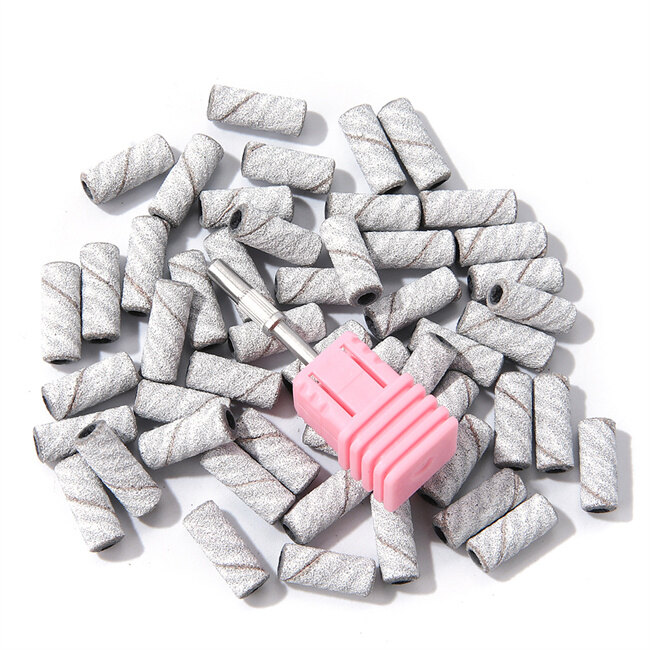
Nail sanding bands are a type of nail art tool that is installed on a nail drill to achieve the grinding, polishing and trimming of nails. These sanding bands are usually made of wear-resistant materials such as carbide or stainless steel, and have different roughness to suit different processing needs.


Features of Nail Sanding Bands
Efficiency
Nail sanding bands can quickly and effectively polish the surface of nails, remove dirt, grease and dead skin, and lay a good foundation for subsequent nail care steps. Compared with traditional manual sanding methods, the use of nail sanding bands can greatly improve the efficiency of nail processing and save users’ time.
Diversity
Nail sanding bands are available in a variety of mesh options, ranging from coarse to fine, to meet different processing needs. Coarse sanding belts are suitable for initial sanding and removing thick cuticles, while fine sanding belts are suitable for fine polishing and sanding. These sanding belts are not only suitable for sanding and polishing nails, but also for removing glue, gel and other residues on nails, and have a wide range of applicability.
Durability
Nail sanding bands are usually made of high-quality materials such as carbide and stainless steel, which have strong wear resistance and corrosion resistance, which can ensure that the sanding bands maintain stable performance during long-term use.
Safety
Compared with other sanding tools, nail sanding bands are gentler when used, which can reduce the risk of damage to nails and surrounding skin. By adjusting the speed and force of the nail drill, users can easily control the polishing effect of the nail sanding bands to avoid over-polishing or damaging the nails.
Convenience
Many nail sanding bands sets are equipped with portable storage boxes or packaging bags, which are convenient for users to carry and use.
Easy To Clean
After use, users can easily clean the residue on the nail sanding bands to keep them clean and hygienic.
Components of Nail Sanding Bands
Sanding Band Body
Nail sanding bands are usually made of wear-resistant materials such as silicon carbide, aluminum oxide or stainless steel. These materials have good wear resistance and corrosion resistance, which can ensure that the sanding bands maintain stable performance during long-term use. The sanding band body is the core part of the nail sanding band, which contains abrasive particles for grinding and polishing. These particles are fixed on the substrate and tightly bonded to the substrate through a specific adhesive or process. The sanding band body is in direct contact with the surface of the nail, and removes dirt, grease, dead skin, and residues such as glue and gel on the surface of the nail through rotation and friction, while achieving nail grinding and polishing.
Connecting Parts
For nail sanding bands that need to be installed on nail drills, they usually have connecting parts that match the drills, such as sleeves, snaps or threaded interfaces. These connecting parts ensure that the sanding bands can be firmly installed on the drill and remain stable and do not fall off during use.
Types of Nail Sanding Bands
Coarse Sanding Bands (Low Mesh)
Coarse sanding bands including 80#, 120#, etc., are suitable for preliminary grinding and removing dirt, grease and dead skin on the nail surface.
Medium Sanding Bands (Medium Mesh)
Medium sanding bands including 150#, 180#, etc., are suitable for further grinding the nail surface to make it smoother.
Fine Sanding Bands (High Mesh)
Fine sanding bands including 240#, 320#, etc., are suitable for fine polishing and grinding to make the nail surface smooth and delicate.
Material
Choosing materials with high wear resistance, such as silicon carbide, aluminum oxide, etc., can ensure that the sanding belt maintains stable performance during long-term use. Make sure the material is non-toxic and non-irritating to avoid damage to the skin during manicure or pedicure.
Grit
The grit determines the coarseness of the sanding particles on the surface of the sanding belt. Sanding belts with low grit (such as 80#, 120#) are suitable for preliminary grinding and removing dead skin, sanding belts with medium grit (such as 150#, 180#) are suitable for further grinding the nail surface, and sanding belts with high grit (such as 240#, 320#) are suitable for fine polishing. Choose the appropriate grit according to specific usage needs. If you need to quickly remove dirt and dead skin on the surface of the nail, you can choose a sanding belt with a low grit; if you pursue the smoothness and brightness of the nails, you should choose a sanding belt with a high grit.
Shape And Size
Make sure the shape and size of the selected sanding belt match your nail drill or other nail tools. Different brands and models of nail drills may have different belt installation methods and size requirements. Choose sanding belts of different shapes (such as round, oval, square, etc.) and sizes as needed to adapt to nails of different shapes and sizes.
Economy And Durability
On the premise of ensuring quality, consider the price factor of the product and choose nail sanding bands with high cost performance. Choose wear-resistant and durable sanding belts to reduce replacement frequency and cost.
Daily Cleaning
After use, remove nail scraps, dust, grease and other impurities left on the sanding belt in time. This helps to maintain the sharpness and service life of the sanding belt. Use a soft cloth or paper towel to gently wipe the surface of the sanding belt, and avoid using too rough or chemically strong detergents to avoid damaging the sanding belt.
Dry Environment
Store the sanding belt in a dry, ventilated place, avoid humidity and high temperature environment to prevent it from deformation or mold.
Avoid Squeezing
Do not stack the sanding belt or subject it to heavy pressure for a long time to avoid deformation or damage.
Classified Storage
If there are multiple types of sanding belts, it is best to store them in categories for easy search and use.
Regular Inspection
Check the wear of the sanding belt regularly. If it is found to be severely worn or deformed, it should be replaced with a new one in time. For sanding belts with connecting parts (such as the sanding belts on electric nail grinders), it is also necessary to check whether the connecting parts are loose or damaged to ensure safe use.
Correct Use
When using the sanding belt, maintain appropriate force and speed, avoid excessive force or too fast movement to avoid damaging the sanding belt or nails. Try to keep the sanding belt in even contact with the nail surface to avoid over- or under-polishing of certain areas.
Application of Nail Sanding Bands
Nail Art Application
Nail sanding bands can quickly and effectively polish the surface of nails, remove uneven parts, and lay a good foundation for subsequent nail care steps (such as coloring, attaching accessories, etc.). Through sanding belts with different meshes, you can achieve a grinding effect from coarse to fine to meet different nail art needs. The coarse sanding belt has larger sanding particles, which is suitable for removing dead skin and cuticles around the nails, making the edges of the nails cleaner and neater. Using nail sanding bands can easily trim the shape of nails, such as round, square, oval, etc., to make the nails more beautiful. Fine sanding belts can be used for fine polishing of the surface of nails, making the surface of nails smoother and brighter.
Foot Care Application
In foot care, nail sanding bands can also be used to remove dead skin and cuticles on the feet, especially on the heels and soles of the feet where dead skin is easily accumulated. By using nail sanding bands for foot polishing regularly, the rough condition of the foot skin can be improved, making the foot skin more delicate and smooth. During the polishing process, proper massage and stimulation can promote blood circulation in the feet, help relieve fatigue and improve problems such as lower limb edema.
Frequently Asked Questions
As one of the most professional nail sanding bands manufacturers and suppliers in China, we're featured by quality products and good service. Please rest assured to buy customized nail sanding bands made in China here from our factory.
grit sanding bands, sanding band for natural nails, medium grit sanding band